
Gargnano:
Churches and monasteries
- Gargnano
If you’d like to discover what to see in Gargnano on Lake Garda, its churches and monasteries offer a journey rich in history, sacred art and traces of the past, set against a backdrop of great charm.
Churches and monasteries
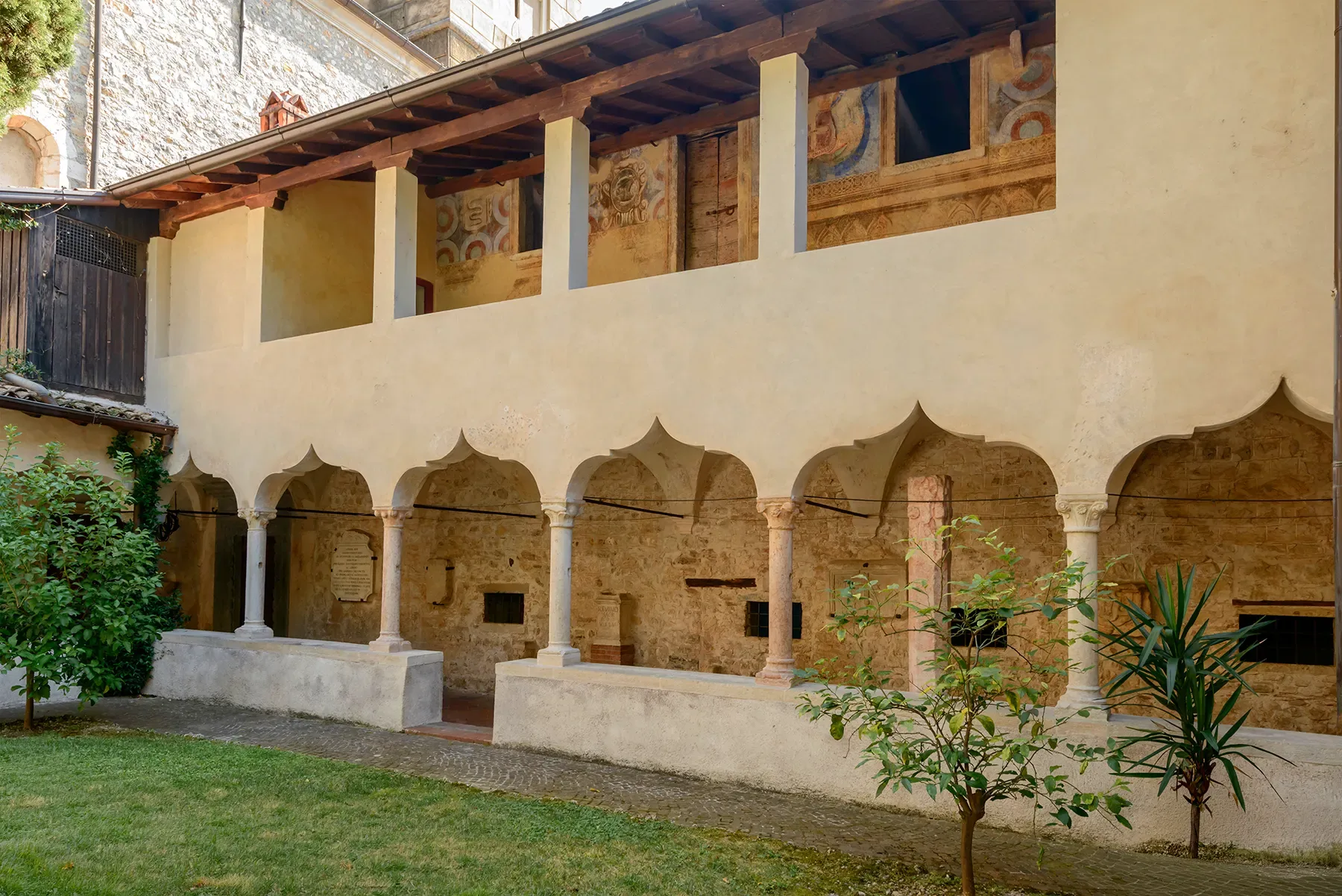
Chiesa e Chiostro di San Francesco
The church was built in Gargnano in 1289 by Franciscan monks commissioned by the Bishop of Brescia. The exterior retains its simple and rough Romanesque style. The facade has a votive statue (1301) depicting the image of St. Anthony of Padua. The interior of the church contains paintings by Giovanni Andrea Bertanza and Andrea Celesti. The cloister next to the church holds a plaque dedicated to Neptune, and a small altar honouring the local deity, Revino, both from the Roman period. The cloister also contains the 15th-century marble coat of arms of the municipality of Gargnano - the initials C.G. (Communitatis Gargnani) depict a wolf rampant holding a lily between its paws. In 1879, the monastery became the property of the Lake Garda Company, which used it as a warehouse.
Convento di San Tommaso
The original building, of which traces of frescoes remain, dates back to the 14th century. A well-preserved fresco depicts St Liberata (1535). Inside there are three altars: the high altar dedicated to St Thomas, one dedicated to St Andrew the Apostle and one dedicated to St Anna. The monastery adjoining the church, built in 1906 by order of Monsignor Pietro Feltrinelli, was home to Franciscan friars until just a few years ago. Today it houses the Centre Européen de Rencontre et de Ressourcement directed by Father Bruno Ducoli.
Chiesa di San Giacomo
St James is the oldest Romanesque church of the Garda region and is of great artistic interest, with frescoes from the 14th century. On the external wall there is a clearly visible fresco of St Christopher with the Child on his shoulders. It was life-size so that it could be seen from far away. In fact, passers-by who gazed upon the image of the saint would be protected from sudden death for the entire day. The altar is dedicated to St James the Greater and houses a wooden statue that dates back to 1501. The present door dates back to the 16th century, as do the two square windows, opened for St Carlo Borromeo on the occasion of his Apostolic Visit in August of 1580.